Shopping cart

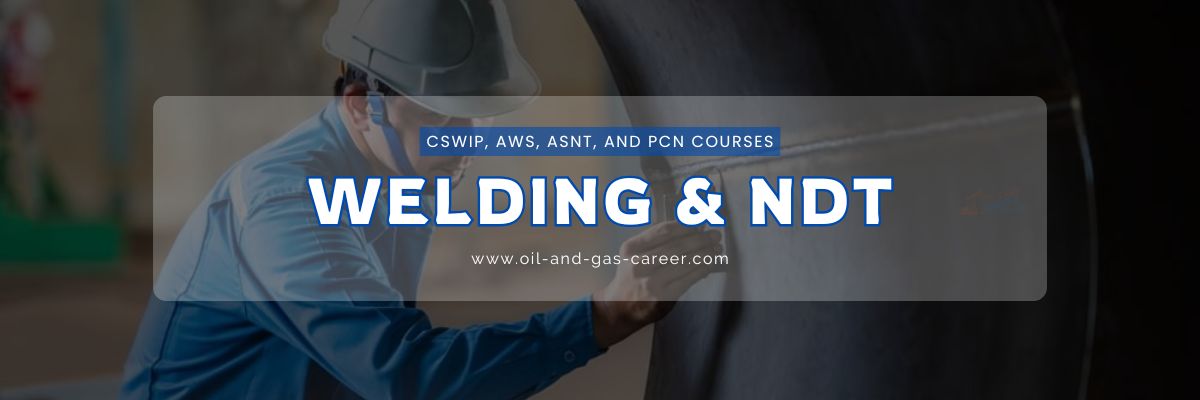
Welding and NDT

welding and NDT courses

đź”§ Welding and Non-Destructive Testing Works in the Oil and Gas Industry

Overview

Welding and Non-Destructive Testing (NDT) are both vital disciplines within the oil and gas industry for maintaining structural integrity, safety, and regulatory compliance in upstream, midstream, and downstream assets. Welding creates joins in pipelines, pressure vessels, platforms, and subsea structures, whereas NDT ensures that such joints and components remain functional. Welding inspection is located at the intersection; inspectors utilize NDT methods to evaluate weld quality and code compliance.

Core Technical Scope

Welding Works

  • Common Processes: SMAW, GTAW, FCAW, SAW, GMAW.
  • Applications: Pipeline welding, spool fabrication, structural steel for platforms, pressure vessel fabrication, and repair welding for both offshore and onshore locations
  • Quality Controls: Welding Procedure Specifications, welder qualification tests, post-weld heat treatment, and welding inspection using visual and NDT methods.

NDT Works

  • Primary Methods: Radiographic Testing RT, Ultrasonic Testing UT, Magnetic Particle MT, Liquid Penetrant PT, Eddy Current ET, Acoustic Emission AE.
  • Typical Uses: Weld inspection, corrosion mapping, thickness measurement, flaw detection in pipelines, tanks, and pressure equipment.

Roles: NDT technician performs tests; NDT Level 2 and NDT Level 3 certified individuals set up procedures, interpret results, and sign reports ITR).

Types of Inspector and Technician Roles

Role

Core Duties

Typical Certification

Welder

Execute welds to WPS; perform weld repairs.

Welder qualification tests; trade certificates.

Welding Foreman & Supervisor

Specialize in pipeline welding techniques, field jointing, and hot tapping.

API, ISO, TWI, AWS in welding courses; trade certs.

Welding Inspector

Visual inspection, review WPS, witness tests, and coordinate NDT.

Welding inspector course leading to CSWIP welding inspector or AWS welding inspector.

NDT Technician

Perform NDT methods under procedure; collect and record data.

NDT Level 1 and Level 2 certifications.

NDT Level 3

Interpret results, calibrate equipment, and supervise Level 1 & 2.

ASNT SNT‑TC‑1A / employer-based or formal ASNT programs.

Welding/NDT Engineer

Design inspection plans, failure analysis, RBI input.

Engineering degree + inspector/NDT certifications.

Popular Certifications and What They Mean

  • CSWIP welding inspector Suite — includes visual and higher-level inspector credentials; CSWIP 3.1 and CSWIP 3.2 are widely recognized for welding inspection competence in the oil and gas projects.
  • AWS Certified Welding Inspector CWI — globally recognized credential for welding inspection and quality assurance/control.
  • ASNT NDT Level 2 & 3 — authorizes technicians to perform and interpret NDT independently across methods.

Training Pathways, Courses, and Typical Curricula

Welding Pathway

  • Basic Welder Courses: Blueprint reading, joint preparation, SMAW/GMAW practice, safety.
  • Advanced Pipe Welding Courses: Pipeline codes, bevelling, fit‑up, hot work, field welding techniques.
  • Welding Inspector Course: Visual inspection of welds, codes and standards, acceptance criteria, report writing; prepares candidates for CSWIP 3.0, 3.1, 3.2 or AWS CWI exams.

NDT Pathway

  • NDT Foundation Visual Testing VT, safety, basic metallurgy.
  • Method Specific Courses PT, MT, UT, RT, ET with practical labs.
  • NDT Level 2 & 3 Course Theory and practical exams, procedure writing, interpretation, and reporting.

Training Institutions and Course Providers

Internationally Recognized Bodies

  • TWI offers CSWIP training and preparation for welding inspector exams.
  • American Welding Society AWS Provides CWI training and resources.
  • ASNT provides NDT certification frameworks and Level 2 programs.

Career Prospects and Progression

Typical Progression Routes

  1. Entry Welder or NDT Level I technician.
  2. Mid-Level Pipe welding specialist or NDT Level 2 technician; Welding inspector after completing a Welding inspector course and certification.
  3. Senior Welding/NDT engineer, QA/QC manager, asset integrity lead, or specialist consultant (CSWIP 3.1/3.2 or AWS CWI often required for senior inspection roles).

Demand and Salary Outlook

  • High demand in pipeline construction, offshore fabrication, FPSO projects, and petroleum refinery construction and turnarounds.
  • Premium pay for certified inspectors and NDT Level 2 technicians due to safety-critical responsibilities. Market rates vary by region and project type.

Comparison of Welding Career Versus NDT Career

Attribute

Welding Career

NDT Career

Work Style

Hands-on fabrication; field heavy.

Inspection, testing, analysis; field and office.

Certifications

Welder quals; optional inspector courses.

NDT Level I/II; ASNT or employer schemes.

Advancement

Senior welder → foreman → welding inspector/engineer.

Level II → Level III → NDT engineer/manager.

Earnings Potential

Good for specialists in pipe welding.

Higher for Level II/III inspectors and engineers.

Mobility

High demand in construction phases.

Continuous demand for inspection across the lifecycle.

Practical Steps to Enter and Advance

  1. Start with a trade course in welding or a foundation NDT course at a recognized technical institute.
  2. Gain field experience on fabrication yards, pipeline projects, or refineries.
  3. Take a Welding inspector course and prepare for CSWIP 3.1/CSWIP 3.2 or AWS CWI, depending on the target market.
  4. Pursue NDT Level 2 for autonomy in testing and reporting; combine with welding inspection for maximum employability.
  5. Maintain certifications with continuing professional development and recertification where required.


Risks, Trade-offs, and Practical Challenges

  • Regulatory and Safety Risk Poor inspection or uncertified welders can cause catastrophic failures; certifications mitigate this risk.
  • Cost and Time Advanced certifications require investment and experience prerequisites; plan training alongside on-the-job learning.
  • Market Volatility Oil and gas cycles affect demand for fabrication projects; inspection roles are more stable across asset lifecycles.

Recommended Resources and Next Steps

  • Enroll in a local welding or NDT foundation course to build practical skills.
  • Target either CSWIP 3.1/3.2 or AWS CWI for welding inspection credentials, depending on employer preference.
  • Pursue ASNT NDT Level 2 for a recognized NDT technician qualification.

Actionable Career Roadmap Summary

  • 0–12 months Basic welding or NDT foundation course; entry-level job.
  • 12–36 months Accumulate field hours; take method-specific NDT courses or advanced pipe welding training.
  • 36–60 months Prepare for the Welding inspector course and CSWIP/AWS CWI or complete NDT Level 2.
  • 5+ years Move into inspector, QA/QC, or engineering roles; pursue Level III or specialist certifications.
Hi, Welcome back!
Forgot Password?
Don't have an account?  Register Now
SORT By Rating
SORT By Order
SORT By Author
SORT By Price
SORT By Category